
AI is building the Saucelet, and games should get cheaper
· 6 min read
By Phil · building Legitsauce
The Saucelet is being built with AI, top to bottom. The Godot exporter, the firmware, the renderer, the circuit, the pin layout and the tests are all being written and tuned by Claude Opus 5.5. I set the direction, check the results and hold the soldering iron.
And so far? It's going great. Way better than I expected.

Godot in, keychain firmware out
Every Legitsauce game is made in Godot. My exporter, squeeze, turns a Godot project into firmware for the Saucelet. Claude Opus 5.5 wrote it, and keeps making it better.
It compiles the game's typed GDScript ahead of time to native C++, shrinks the art down to the size it's actually drawn on a 240 by 240 screen, and builds firmware. Then it checks its own work. It plays the same button presses through Godot and through the native build, and the full game state has to match frame by frame, every character and every timer, or the export fails. There's more on how that works in Under the hood of the Saucelet.
Nine Legitsauce games go through it today, and all nine pass that frame-by-frame check against Godot:
- Saucelings
- Mimic
- Prism
- Fruit Alchemist
- Dirt Rush
- Space Type 2
- Tower Onslaught
- Beat Runner
- Cosmic: Search and Destroy
Saucelings and Mimic already run at 60 FPS on the chip. Most of the others need the flash chip I'm soldering on now to hold their art, and we're tuning each one to hit a steady 60. Prism's heaviest menus went from 29 to 45 FPS after one round of renderer work, and the next round should get it to about 55 to 60.
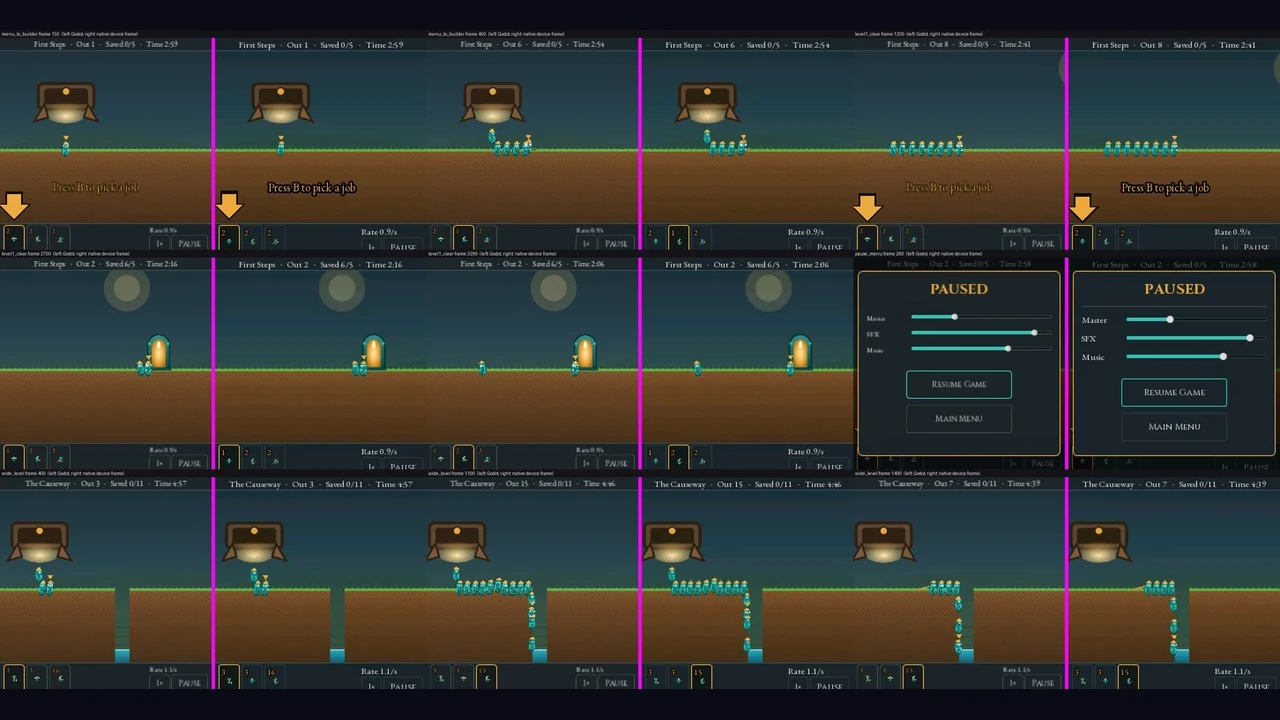
Here's what one day of AI work on the exporter looked like:
- Real music compression. It added the Opus music codec (no relation to Claude Opus, heh). Beat Runner has 36 songs, and 20 of them now fit on the device.
- Smaller level data. Level and song data is compressed and only loaded when the game needs it.
- A faster renderer. The drawing work per frame got cut roughly in half.
- Tests for all of it. Every change comes with automated tests, and the frames have to come out pixel for pixel the same as before.
That's a day. Work like that used to take me weeks of free time, if I ever got to it at all.
Hardware, from a total beginner
I'm a novice at electronics. Before this project I couldn't have told you what a pull-up resistor was for. The same AI that writes the exporter also picked the parts, laid out the wiring, and tweaked and optimised the design with me, one breadboard at a time.
The breadboard prototype today:
- A Seeed XIAO RP2350, the brain, at stock clocks. No overclocking.
- A 1.3 inch 240 by 240 screen.
- A little amplifier and speaker for sound.
- A 16 MB flash chip for game art, which I'm soldering on now.
It's built for NES-quality games at a smooth 60 FPS, and the Legitsauce games above are lining up behind Saucelings and Mimic. Full Legitsauce support on the device is the goal, and it's coming fast.
What it costs
Here's the parts list at single-unit prices:
| Part | About |
|---|---|
| Seeed XIAO RP2350 | $5 |
| 1.3 inch 240 by 240 screen | $6 |
| Amplifier and speaker | $5 |
| 16 MB flash chip | $3 |
| Button chip, 13 buttons and resistors | $2 |
| Battery | $10 |
| Capacitor, wire and board | $2 |
| Total | about $33 |
That's under $35 for a 240 by 240 game machine running at a smooth 60 FPS, and it's less than a colour Tamagotchi costs in the shops. Buy in bulk and it gets a lot cheaper. The screen alone is about $1 to $2 at volume, the battery about half price, and a custom board can use the bare chip instead of a whole dev board. Two to three times cheaper is realistic.
From slop to shipping
Not long ago, my AI posts were mostly about what went wrong. A captain's jacket that turned into jagged strips the moment she moved. Concept art that came back as a bald clay head. AI still can't do everything. But for code, it went from producing slop to a real contender, one that builds prototypes and ports in minutes to hours.
Legitsauce and Bemi Holdings are all in on AI. It's not going away. It's too powerful. Studios that refuse to use it in games will get left behind by the ones that do.
Games should get cheaper
Here's the part I care about most.
When making games gets cheaper, games and consoles should get cheaper too. But hoping the big companies lower their prices on their own is a pipe dream. Console prices keep creeping toward $1,000. Games cost $70 and up, and then they add in-app purchases, pay-to-win and ads on top. That's not acceptable. I wrote about where that leads a while ago, and it's why I built Legitsauce in the first place.
The way prices come down is competition. And right now, a hobbyist with a roughly $200 a month AI subscription (for now) can build things that used to need a whole team. If hobbyists get there first, prices should drop to something normal. Maybe $50 for a AAA game and $30 for smaller titles.
So use today's cheap AI now. Break the monopoly of the big game and console makers while the tools are this cheap.
The human still steers
Direction is still the most important part, and that's my job. What the Saucelet is, which games go on it, what good enough looks like, and when something feels wrong in the hand.
The rest is mostly automated. The AI writes the code, and a test harness checks it. Every game has recorded play sessions that have to match Godot frame for frame, and every change has to pass hundreds of automated tests before it counts. I supervise now and then, and step in when the direction needs to change.
Create, and create fast
Hobbyists, we need to create, and create fast. That's how we force competition and push the big studios to stop being greedy.
I'm doing my part with the Saucelet: a keychain game console that costs less to build than one new AAA game costs to buy, with 3D on the way in the Saucelet Extra. It's coming in spring 2029. Follow along right here, and I'll keep posting as it comes together.
If you're building something with AI too, tell me about it.